
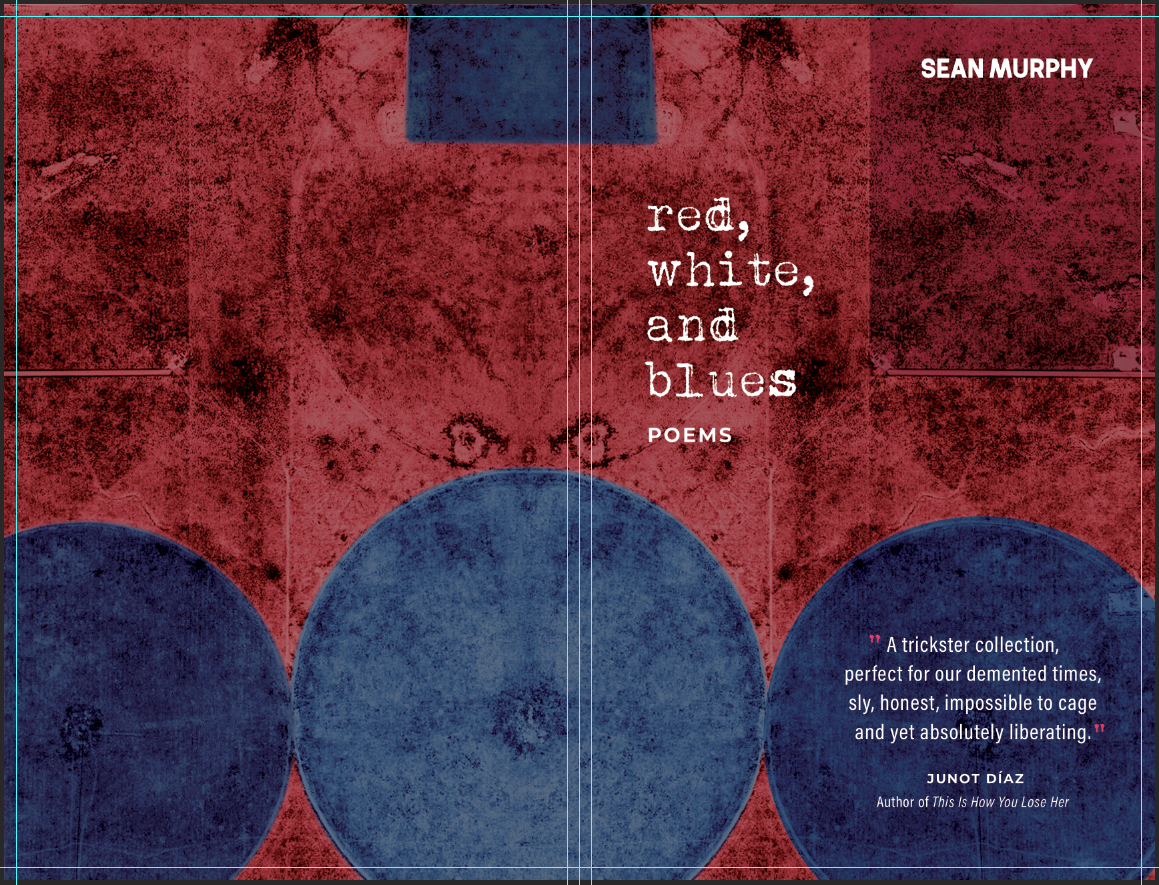
Two questions every author is asked, which theoretically should be easy to answer.
What’s your book about?
Why / When / How did you write it?
Well…
Here’s a distillation of the official boilerplate, via my website:
Red, White, and Blues is the fourth installment of a large, ongoing project (that) explores America and its mythology through poems that function as biography, history, and cultural commentary. Where earlier collections focused primarily on jazz and blues musicians, this volume turns its attention toward politics and the figures who have shaped—and distorted—our shared cultural imagination. A moral cross-examination spanning history, war, religion, and pop spectacle, the collection asks what we worship, what we excuse, and what the stories we tell do to us.
The less formal reply would be at once simpler and more complicated. Almost exactly a decade ago I hit upon the idea of channeling my interest in (or obsession with) politics, culture, and creativity into poems. The key conceit was attacking issues via individuals and, ideally, a specific moment—a famous incident or song or quotation or, in some instances, a physical trait, thereby putting a premium on words and images, doing in one or two pages (often much less) what would typically take several thousand (often much more) words via an essay, review, or blog post.
Sometimes you just need the concept and then you see if the creative juices flow. Now more than 100 poems into the project, I wouldn’t say I’ve been unusually productive so much as I discovered a way to turn so much of what I read or think about (or love, or hate) into poems. Thus, it becomes a manageable and satisfactory format for dealing with history or how culture is shaped by myth and story, hence how history is made (and read, and taught, and received). Where even the most compelling political essay necessarily has a shelf life, my hope is that many of these poems are, for lack of a better cliché, timeless, because they are grappling with “timeless” themes like…racism, sexism, violence, corruption, capitalism.
See? Even typing that last sentence felt pretentious, a feeble way to even describe something many of us understand—and are often profoundly moved by. So: there’s nothing, to my mind, feeble or pretentious about a poem that deals with the life-altering beating jazz legend Bud Powell’s suffered at the hands of NYC cops, or considering John Coltrane’s cancer as a metaphor for what this world consumes for artistry to endure. Or how Richard Pryor’s self-immolation says so much about…so many things, or the ways Christopher Columbus (the name alone invoking colonialism and conquest) mistaking manatees for mermaids offering ample of evidence of the ways men have historically subjugated and failed to appreciate (much less understand) women. And so on.
The previous three collections (The Blackened Blues, Rhapsodies in Blue, and Kinds of Blue) have featured a great many musicians from jazz and blues genres, with the occasional writer, painter, and movie star thrown in. All the poems are, by design, political, but the poems themselves seldom dealt explicitly with politics. With red, white, and blues, the thematic throughline is politics, but specifically how the American imagination, historically very male and white, and fascinated by mythology, has shaped all aspects of our culture. Part of my impulse is the challenge of trying to cram an entire life into a single poem, but I’m also both challenged and intrigued by homing in on a situation or summary that reveals character. Put another way, what more might be said about Nixon or Kissinger? Is there anything new under the sun? Well, listing out Kissinger’s “achievements” via an imaginary CV, or looking at Nixon vis a vis Vietnam by sneaking in the back door via a movie (Who’ll Stop the Rain) based on a Robert Stone book (Dog Soldiers) is certainly a fun and, I dare say, original way. Part of this is selfish: it’s more gratifying (if more difficult) to show, briefly (which is what poetry does) vs. telling, at length (which is often what essays or reviews do), and this approach is readymade for metaphor and allegory.
Deconstructing figures like Ronald Reagan, Roy Cohn, Jeff Bezos, and Elon Musk, this collection dissects the ideologies and decisions that did—and in some cases, still do—impact countless lives. Fractious events including George Custer’s massacre of Native Americans, the police beating of Rodney King, and Rudy Giuliani’s notorious crackdown on the homeless in New York City are remixed with necessary nuance, resulting in perspectives seldom offered via mainstream media. Fictional legends (many inspired by real figures) such as Willy Loman and Gordon Gekko, and key scenes from films like Apocalypse Now, Wall Street, and Blade Runner, get placed under the microscope, exposing how certain world views can alter world history. We also go deep inside “the blackened blues” to see how icons like Jack Johnson, B.B. King, and Curtis Mayfield serve as ceaseless sources of inspiration but also testaments to a type of endurance America requires of its geniuses.
I wrote red, white, and blues because I believe poetry can still tell the truth when other forms have failed us. These poems are not interested in neutrality; they are interested in clarity. They move through history and pop culture because that is where our myths live—where power learns to hide and where harm learns to look inevitable. (I also have come to believe poetry is the best way to mash up history, media, political commentary, and a succinct formula for connecting dots in ways Op-Eds, fiction, and social media grandstanding can’t and won’t—see below). I wanted to write a book that names what we worship, what we excuse, and what we leave behind, while still honoring the strange, stubborn beauty that survives in language. If these poems bruise, I hope they also invite conversation. If they provoke, I hope they also connect. Art matters because it reminds us that we are not alone in our witnessing.
