
Some Thoughts on International Jazz Day
i.
A drowning man can be pulled from the water, and who wouldn’t celebrate that act of compassion, that gesture, that gift of life? But why was that person trying to drown himself in the first place? What was it about his life made him figure it wasn’t worth continuing it?
Jazz, quite frankly, has saved my life, and not just on myriad occasions, but rather it’s had the cumulative effect of improving it, expanding it, enhancing it, making me aware of what a miracle it is that, in no particular order, we’re here, I’m here, and that others who have passed on were here, and left such extraordinary gifts. It’s because jazz music exists, and is accessible to me, that has undeniably made my life better than it could possibly have otherwise been. That’s what I celebrate, and what I’m so profoundly grateful for. If I hadn’t discovered jazz I guess I would never have known what I was missing, but just like, in no particular order, the joy of good sex or the heaven of movies from the ’70s, or the writings of Martin Amis, I could have, conceivably, lived a perfectly content life but…you get the picture.
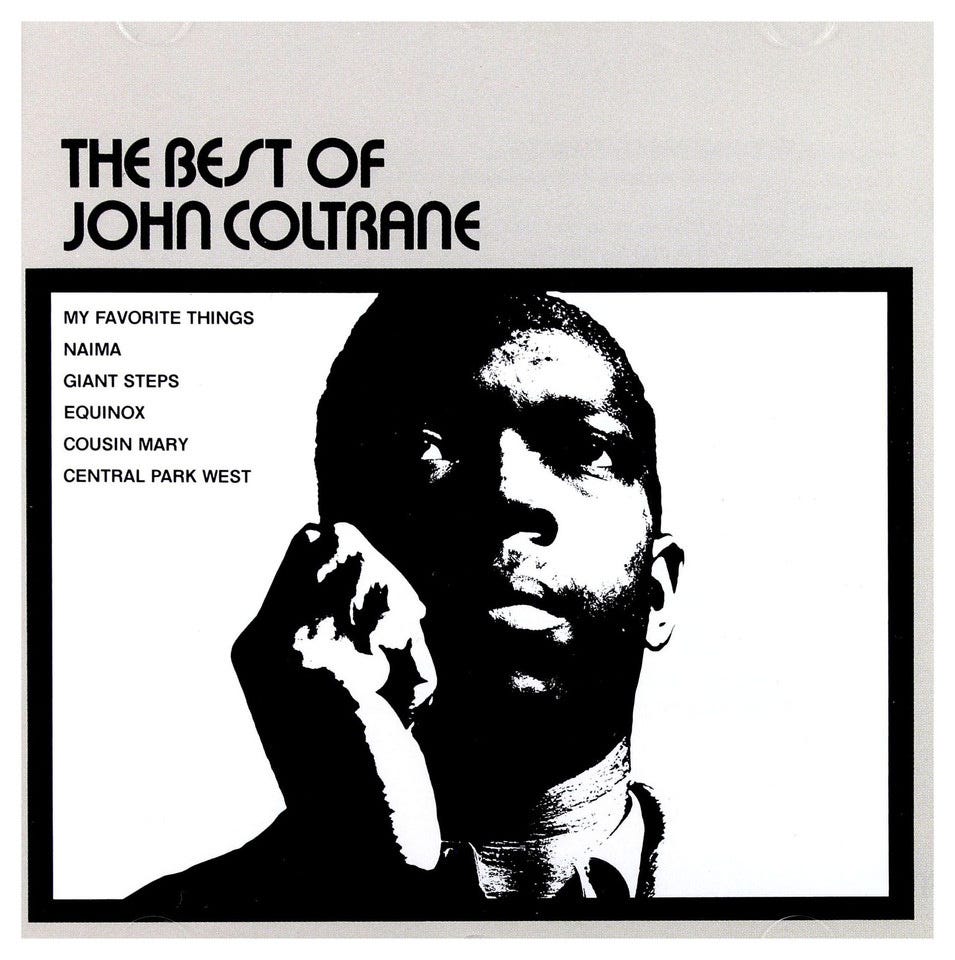
I’ve written about the disorienting sense of discovery, the surreal and transformative experience of hearing Ornette Coleman for the first time; it was the following month, home for the holidays during my senior year of college, that I was wise enough to acquire a single compact disc that further changed the course of my life, that put me more squarely on the path I still walk today. So yes, it’s equal parts nostalgic and sentimental, but just like I remember scoring my first goal on a soccer field, or falling in love for the first time, or having my first poem published, listening to John Coltrane (at his most accessible, which is why this was the single album — alongside the obligatory Kind of Blue — that I did, and do, recommend for newcomers).
ii.
This album (CD) kicks off with “My Favorite Things” which, in 1961, had not become a movie yet — so Trane was truly melding worlds while forging paths. This was the one I could not stop listening to. In part because it was so familiar, yet Coltrane & Co. (especially pianist McCoy Tyner — about whom more shortly) were stretching the possibilities of how I could imagine this simple composition, pushing boundaries and making me think differently (and not just about music or even creativity, but…everything). Not unlike great literature, so much I’d been told about jazz revolved around how difficult it was, how abstruse, how you had to be a musician (or, with great books, an English major if not a writer) to “get” it. Here, early in my education, was proof that the only thing required was time and open ears. And while I (sort of) understood the sounds Coltrane was making, it was that piano that made me feel like I was on some drug not yet invented. As it happens, it had been invented, and it was called jazz.
McCoy Tyner is, without question, one of the most gifted and influential pianists inside (or outside) jazz, and his legacy is — and will remain — a gift that gives so long as we have ears to hear it. A gentle man with a left hand like a sledge hammer, McCoy was a consistent and profound force for good in the 20th (and 21st) Century. Listen to him throughout this masterpiece and feel everything unimportant slip away as you find yourself in a place of peace and indescribable joy. (This song is miraculous in every way, embracing cliche and sentimentality head on, only to turn them into the service of scorching, searching, insatiable pursuit of beauty, but is also an ideal gateway drug for any and all who claim to either loathe or not understand jazz. This is an easy portal to stroll through.)
iii.
As it happens, Coltrane’s masterpiece, A Love Supreme, celebrates its 60th anniversary in 2024 (last year).
It’s not, as mentioned above, where I’d advise a newcomer to begin, but once jazz (in general) and Coltrane (in particular) start speaking to you, it’s difficult to imagine any openminded listener engaging with this music on its own accessible but challenging terms and remain unmoved. Quite the contrary, it seems safe to suggest that anyone experiencing this music for the first (and, hopefully, subsequent) time(s) will see and hear the world differently. And that’s the entire point.
(Flashback to a short tribute, written in the early 2000s: A Love Supreme remains, after all this time, the apex of his composition and playing: while I respect, and remain in awe of, the longer workouts, which became increasingly intense, frenzied and loud after 1965, I can only absorb them in small doses. It’s not merely that he hit the mark so clean and clear on A Love Supreme, but he accomplished what so few artists are able to do, which borders on miraculous: he filtered all that intensity into a perfect chalice. After this recording the cup was forever too full, and but for the most faithful or forgiving listeners, the famous sheets of sound became a tsunami: uncontainable, too much for the human ear; his canvas, after all, was the entire world that he saw, but I don’t know if ever before, or after, his vision was so focused and peaceful. Or put another way, the earlier work was drizzle, then steady and certain rain; after 1965 it was hurricanes and tornadoes; on A Love Supreme it’s a thunderstorm: there’s lightning, thunder, lots of loud, torrential rain; but it is a summer day, the ground is warm, and you know you are safe. So you sit back and let this force of nature wash over you and refresh and renew you. Eventually, the rain has stopped and you open your eyes and wonder how you’ll ever live without it.)
iv.
To understand the trajectory that took Coltrane from sheets of sound to A Love Supreme, it’s instructive to consider his composition “Alabama,” recorded in 1963. Inspired by the disgraceful 16th Street Baptist Church bombing, Coltrane said of his elegy: “It represents, musically, something that I saw down there translated into music from inside me.” It is one of his enduring and devastating performances wherein Coltrane, already considered amongst jazz music’s most emotional and sensitive players, manages to articulate the grief and the rage the occasion called for. A deeply spiritual man, Coltrane conveys the immutable senselessness of violence instigated by ignorance, but also hints at the redemption of peaceful power through unified awareness. As only he could, Coltrane crafts a solo that is angry, somber, and somehow hopeful; a subdued epitaph for the innocent dead, but also a rallying cry for the not-so-innocent bystanders who needed to join the cause. The Alabama bombing was a tipping point in the civil rights movement, and Coltrane captured that moment where confusion and rage inspired an outpouring of solidarity.
A quote from Flannery O’Connor: “Dear God please help me to be an artist, please let it lead to you.” It’s clear that, for O’Connor, the journey was as important as the destination: being a good Catholic, she not only accepted that she’d have to suffer, she expected it. Coltrane’s suffering, for some time, involved the self-imposed heroin addiction he finally kicked in 1957 (years of alcohol abuse undoubtedly contributed to his eventual liver cancer). The liner notes to A Love Supreme, written by Coltrane and addressed to the audience (Dear Listener, they begin) leave little doubt what the album was “about” and exactly what inspired its creation — and its creator:
ALL PRAISE BE TO GOD TO WHOM ALL PRAISE IS DUE. Let us pursue Him in the righteous path. Yes it is true; “seek and ye shall find.” Only through Him can we know the most wondrous bequeathal. During the year 1957, I experienced, by the grace of God, a spiritual awakening which was to lead me to a richer, fuller, more productive life. At that time, in gratitude, I humbly asked to be given the means and privilege to make others happy through music.
It might be suggested we’ve never seen, in modern art, more abundant or eloquent evidence of Art leading to God than A Love Supreme. (And, if we can collectively embrace the notion that “God is Love”, no ecclesiastical concerns need sully the discussion.) It serves as a consecration of sorts, a personal yet intensely spiritual expression: finally, Coltrane was able to filter all that intensity into a perfect chalice, never before, or after, was his vision so focused yet peaceful. The music — and message — is a force of nature the listener must let wash over them, while repeated listens will refresh and renew.
Coltrane reached a point where he attempted to achieve some type of artistic if not spiritual consecration. He then went even further and sought to transcend the insanity altogether, altering consciousness through a profoundly moving colloquy. That he attempted this is remarkable; that he was able to achieve it remains miraculous.
v.
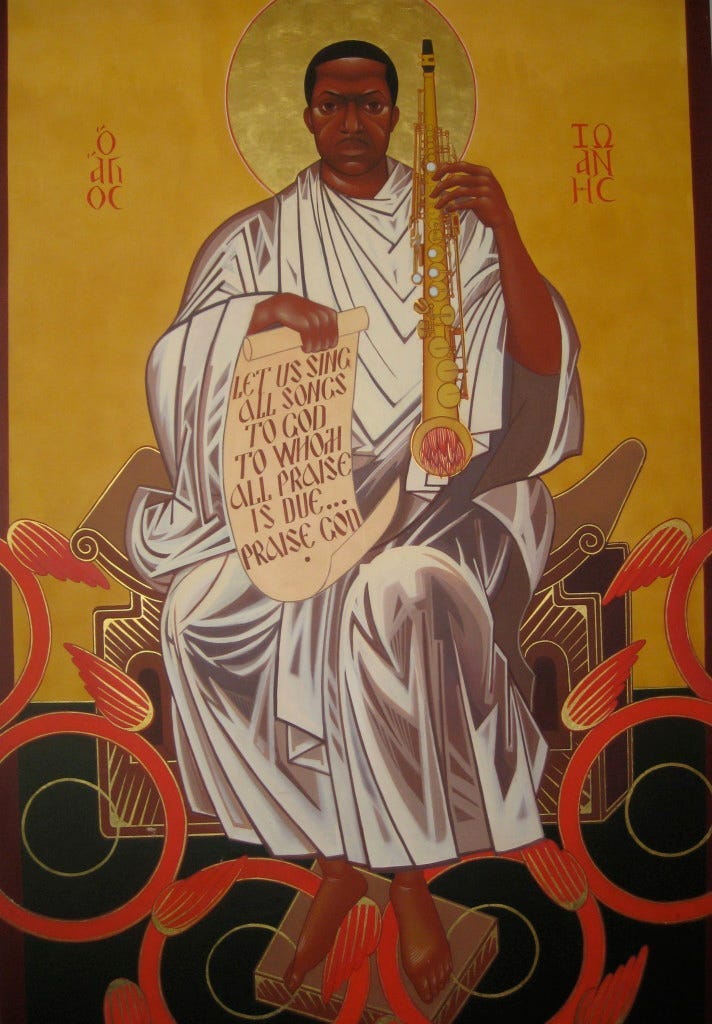
John Coltrane’s Cancer
Coltrane’s calling: all he did was everything
In his power, throwing sparks at the darkness,
Extolling what he alone conceived — the Divine
Alchemy of his own design, sheets of sound
with no barriers between pursuance, his spirit,
and interstellar space, this gift a supreme kind
Of Love.
But like some indefatigable oyster, filtering
the sins from a fathomless sea, he transformed,
instigating storms no human being can contain.
And like any authentic prophet, with fire cloaked
as expression, every revelation must supersede
the messenger, even mortality, ever insatiable as
It Is.
And so, those bilious juices grew emboldened,
their corrosive wake drowning him in everything
he tried not to be, leaving him earthbound and
anchored, even as his soul strained, relentlessly
toward infinity. And death, etiolated in the end,
silenced him much as a passing shadow consumes
The Sun.
*from the collection The Blackened Blues (2021).
For newcomers to jazz, here’s a poem as invitation.
How To Talk about Jazz Music
“I’ll play it first and tell you what it is later.” — Miles Davis
The first step’s establishing how not to talk about it. Second, 86 the evangelical vibe: the stakes are so small — even though this should be life or death for those most in need. The only hope is trust that hearing is believing. That’s it, except for everything else making this music so perfectly impossible to describe, jargon being the enemy of art best expressed without it. Also: never forget that jazz offers a reminder of the ways fortune and karma are on friendlier terms with zip codes and family crests than talent or industry — or worse still, a kind of honesty incomprehensible to those fluent in spreadsheets and portfolios measuring moral trash swept out to sea the second the check clears — anti-matter dead on arrival, living off the good deeds of those not built to thrive in this morose arena where soul isn’t material; wealth’s measured by the weight of wallets & cars driven at the highest speeds to nowhere. Third: imagine jazz as a landscape you can’t capture with a camera; how can images begin processing something of that scope? But it’s also nothing like that. Rahsaan Roland Kirk talked about bright moments — those sacred occasions, sometimes lasting only seconds, where one feels deeply connected to the music, the message, the soul of the messenger. Booker Little, only 23 and already being stalked like easy prey by everything unfair about Fate, named his final album Victory and Sorrow, a declaration of defiance as he died like an abandoned Gabriel, his horn signaling revelation even while the world crumbled around him. Ornette Coleman insisted Tomorrow is the Question! and then spent several decades offering clues to satisfy unsoothed minds. Let My Children Hear Music, the mighty Charles Mingus bellowed, like Moses holding up his stone tablets, already aware there was better money to be made elsewhere, the ears of this world always itching for easier sources of amusement. Perhaps it will suffice then, to suggest that jazz is music is, finally, an escutcheon, a spiritual shield for those seeking protection from false prophets. Art is best understood as a succession of prayers already answered, their source a faith that requires no ritual and is both shared and celebrated, without words.
*The first poem from my third collection Kinds of Blue.
