
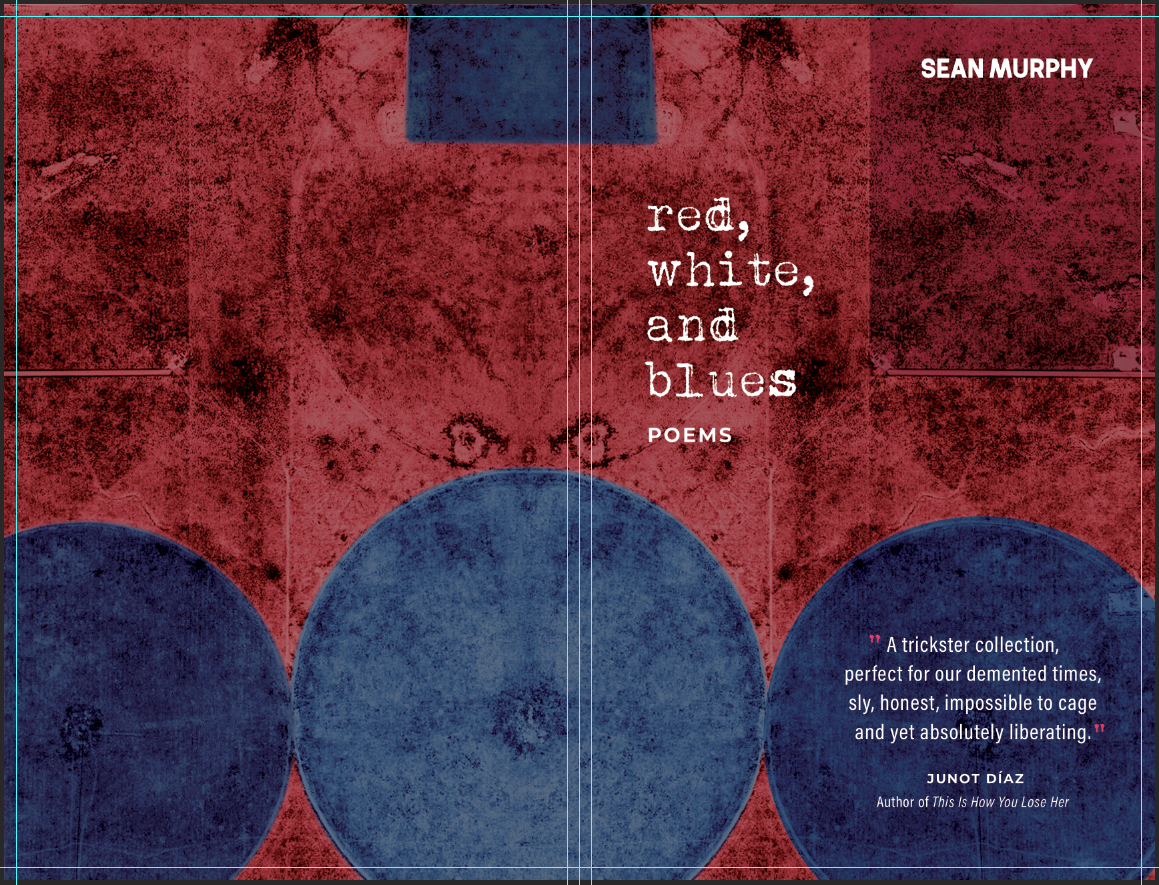
red, white, and blues is the fourth installment of a large, ongoing project acclaimed artist Matthew Shipp describes as “a kaleidoscopic, deep, and opulent journey.” Once more, I’m exploring America and its mythology through a series of poems that function as biography, history, and cultural commentary. Where the previous collections interrogated these concerns primarily through the lens of jazz and blues musicians, these poems home in on politics—and key players who have shaped our shared culture. A moral cross-examination covering history, war, religion, and pop spectacle, this collection asks what we worship, what we excuse, and what the stories we tell do to us.
Deconstructing figures like Ronald Reagan, Roy Cohn, Jeff Bezos, and Elon Musk, this collection dissects the ideologies and decisions that did—and in some cases, still do—impact countless lives. Fractious events including George Custer’s massacre of Native Americans, the police beating of Rodney King, and Rudy Giuliani’s notorious crackdown on the homeless in New York City are remixed with necessary nuance, resulting in perspectives seldom offered via mainstream media. Fictional legends (many inspired by real figures) such as Willy Loman and Gordon Gekko, and key scenes from films like Apocalypse Now, Wall Street, and Blade Runner, get placed under the microscope, exposing how certain world views can alter world history. We also go deep inside “the blackened blues” to see how icons like Jack Johnson, B.B. King, and Curtis Mayfield serve as ceaseless sources of inspiration but also testaments to a type of endurance America requires of its geniuses.
(Author’s note/humble brag: what an indescribable honor to get this blessing of a blurb from Pulitzer Prize winner Junot Diaz, who writes red, white, and blues is “a trickster collection, perfect for our demented times; sly, honest, impossible to cage and yet absolutely liberating.”)
These poems are political, name names, and while I don’t have any illusions my modest efforts can affect the type of meaningful change we desperately need, it’s a flag flown in solidarity, and a middle finger to the establishment. As such, I think it’s coming into the world at the right time—and perhaps can inspire some dialogue or instigate something positive.
I wrote red, white, and blues because I believe poetry can still tell the truth when other forms have failed us. These poems are not interested in neutrality; they are interested in clarity. They move through history and pop culture because that is where our myths live—where power learns to hide and where harm learns to look inevitable. (I also have come to believe poetry is the best way to mash up history, media, political commentary, and a succinct formula for connecting dots in ways Op-Eds, fiction, and social media grandstanding can’t and won’t—see below). I wanted to write a book that names what we worship, what we excuse, and what we leave behind, while still honoring the strange, stubborn beauty that survives in language. If these poems bruise, I hope they also invite conversation. If they provoke, I hope they also connect. Art matters because it reminds us that we are not alone in our witnessing.
Colonel Kilgore’s Concerto
after Apocalypse Now
When the fat lady finally sings it reminds us that Wagner’s operas—which, aside from conquest, were in some quarters considered the singular height of human achievement—tended to celebrate not only war, but war amongst the gods, and more, the twilight of those gods, signaling it was time, at last, for heroes on earth.
When the fat lady sings it reminds us that even in the 20th Century Wagner’s operas, in some quarters, signified that empire was waning, or final solutions needed implementing—depending on which biographies have been updated, which news outlets one relies on, or which political party is inspiring a new kind of recruit for the cause.
When the fat lady sings it’s the militant score for a movie, and once—depending upon what books one reads—served as a soundtrack inspiring if not celebrating murder (of Jews, amongst gods); but mostly, for the purposes of this poem, the fat lady’s song provides the soundtrack to accompany a massacre, itself a reminder that Charlie don’t surf.
More info, coming soon!
