
i.
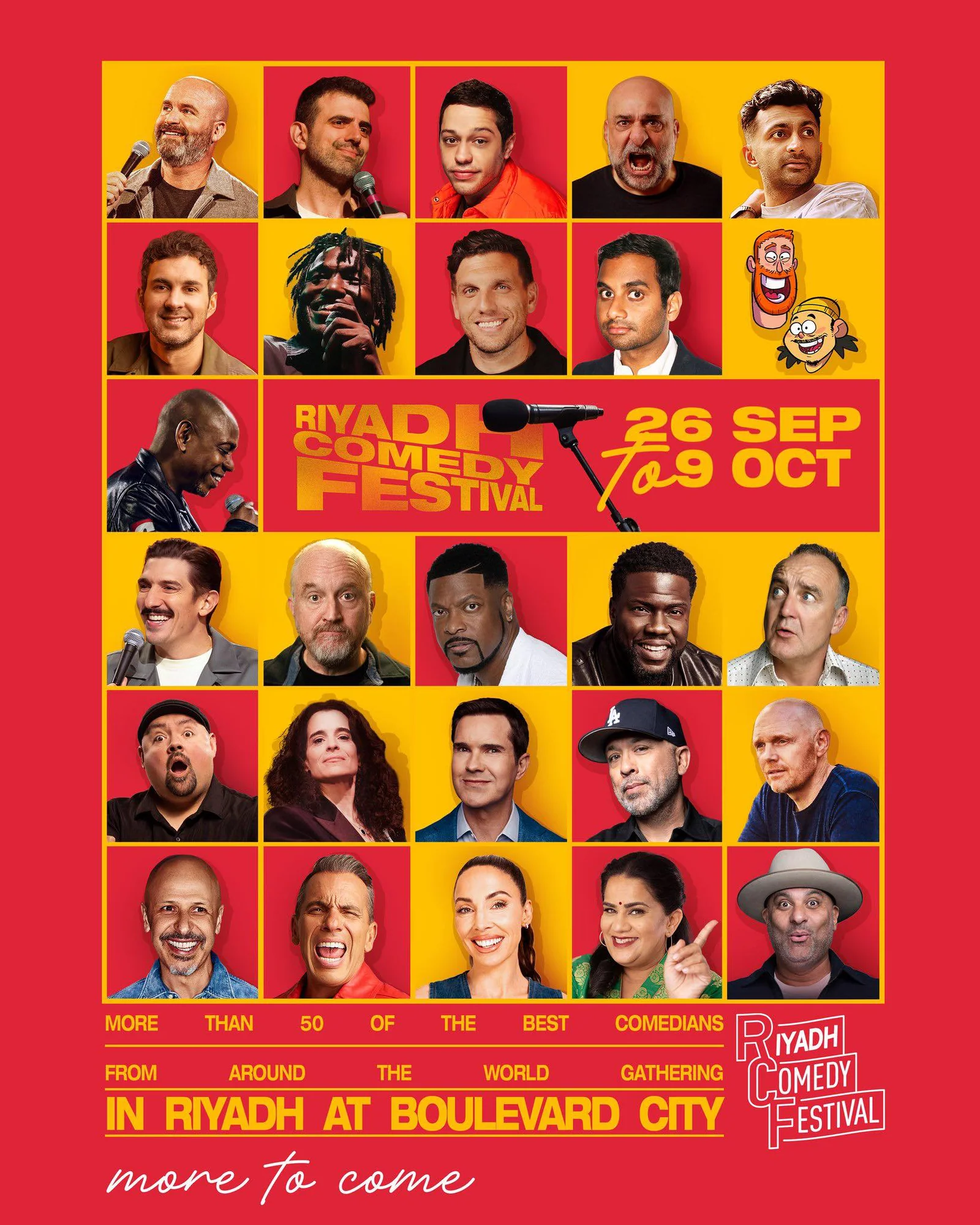
Look, this doesn’t warrant or require a great deal of description or detail. A bunch of hacks sold out.
This Substack is reader-supported. To receive new posts and support my work, consider becoming a free or paid subscriber.
Credit where it’s due, and I’m happy to lead off with two comics who, not coincidentally, have always walked the walk, establishing bona fides and integrity for three decades, David Cross and Marc Maron.
First up, national treasure David Cross (full statement via his site, here):
What do you think I think? I am disgusted, and deeply disappointed in this whole gross thing. That people I admire, with unarguable talent, would condone this totalitarian fiefdom for…what, a fourth house? A boat? More sneakers?
We can never again take seriously anything these comedians complain about (unless it’s complaining that we don’t support enough torture and mass executions of journalists and LGBQT peace activists here in the states, or that we don’t terrorize enough Americans by flying planes into our buildings). I mean that’s it; you have a funny bit about how you don’t like Yankee Candles or airport lounges? Okay great, but you’re cool with murder and/or the public caning of women who were raped, and by having the audacity to be raped, were guilty of “engaging in adultery”? Got any bits on that?
Now look, some of you folks don’t stand for anything so you don’t have any credibility to lose, but my god, Dave and Louie and Bill, and Jim? Clearly you guys don’t give a shit about what the rest of us think, but how can any of us take any of you seriously ever again? All of your bitching about “cancel culture” and “freedom of speech” and all that shit? Done. You don’t get to talk about it ever again. By now we’ve all seen the contract you had to sign.
Tag team, from fellow national treasure Marc Maron (who has been on a mid-career roll the last ten years or so, doing some of his best work ever, on stage and off):
A post shared by @marcmaron
ii.
Who cares that Louis CK or Dave Chappelle—two severely compromised, still beloved, generation-defining talents whose best days are specks in the rear view—threw another piece of their eroded souls into the bonfire of vanities, taking blood money and illustrating, again, there’s no price sell-outs won’t find ways to justify, making them both hypocrites and cowards?
But Bill Burr?
That hurts.
I’ve long maintained, equal parts genuine humility and a modicum of envy, that it’s easier to remain pure if no one’s offering dough to entice you. I’ve never sold out, but no one has ever made any offers. (Maron says something to this effect and considering I’m approximately a fraction of a single percentage as famous, beloved, or culturally relevant as him, I’m coming from a place of extreme and genuine modesty.)
But I can, and will, stand on the conviction—based on my not inconsiderable experience, ranging from academia, running a non-profit, being part of a literary community, hosting a podcast, and a lifelong, avid fan and consumer of all-things writing—that so many of these people we read about, even or especially the most wealthy, are miserable, filled with insecurity, jealousy, pettiness, and a craving for attention that can never be satisfied or sated. And that’s just talking about writers, where the stakes, generally speaking and in terms of both cash and cachet, could hardly be more miniscule.
I’ve resisted writing much about what I consider Dave Chappelle’s artistic and spiritual spiral for a variety of reasons. One, who cares? Two, no honest or reasonable observer would deny that the distance between his prime work, which peaked during the incendiary, miraculous explosion of genius during the two-season run of Chappelle Show, and pretty much everything he’s done in the two decades since is, being generous, extreme, incalculable. But mostly I know better than to spend energy railing against what in American Culture we might describe as a “made man.” This means, once someone becomes so beloved, so sui generis, they are essentially untouchable, they are an avatar (which we now lazily refer to simply as GOAT). When I realize people of my generation casually, almost ritualistically refer to him as GOAT and they haven’t seen old Richard Pryor material, I back off, knowing—kind of like when discussing politics or history with hardcore conservatives—it’s like trying to explain quantum physics to a cricket. There’s no linguistic, logical, or reasonable expectation of meaningful communication.
But where I’m content to, as always, let opinions vary (if someone, anyone, thinks any of Chappelle’s Netflix specials can or should be considered in the same category of his earlier work, more power to them, right?), and on purely artistic levels, I look at DC the way I consider the Rolling Stones: a vital, resonant, influential act who did their best work many, many years ago, and focus on how grateful I am for the work they did at their best. But even before Joe Rogan, DC became the sort of comedic canary in the coal mine for punching down, homing in—for reasons that could keep a good psychiatrist preoccupied—on trans issues. In this, he was gleefully followed by another deeply flawed, compromised, morally fetid comedian in Louis CK. That both men were ostensibly “canceled” and/or ridiculed seemed, to me, the obvious (and pitifully transparent) impetus for their reactionary, profoundly immature reactions. Everything both men have done in the last decade can be traced to a feeling of unwarranted resentment and a lament for when they could do no wrong in the public eye. (I always wanted someone to ask DC, when he was busy defending his buddy, if he would have felt the same way had Louis CK jerked off in front of his daughter. Seriously though: imagine it, and picture how incensed he’d be if his friend—or any critic—asked him that simple, perfectly legitimate question. One might imagine he’d be…offended! Outraged. Which is precisely what he mocks the people upset by his jokes for feeling. But that such a question would never be asked speaks to how deeply unserious we are, in America, about ever holding the powerful to account, to asking even moderately uncomfortable questions, asking people with big platforms and big opinions to do some honest speculation. Ditto, super-sized, for politicians—and it goes a long way, way more than anything woke-related, to explaining why we’ve ended up in this ditch instead of a place where honest discourse occurs and the First Amendment is sacrosanct.)
Naturally, the sociopolitical rot that led to Trump, MAGA, anti-woke sentiment, and the whole bro-sphere led by Joe Rogan, the Paul Revere of self-satisfied bozos (proving that at least once a generation the worst amongst us are rewarded beyond any rational or fair measure for their mediocrity, a farce we’re seeing on steroids right now with the astonishing, infuriating, but ultimately predictable ascension of Bari Weiss at CBS). The old rule inevitably applies: follow the money.
This is beyond shooting fish in a barrel (or beheading journalists with a bone-saw): these same comedians, who were neither accurate nor brave when they received legitimate pushback for views ranging from immature to incendiary to irresponsible, nevertheless climbed astride the “anti-woke!” and “cancel culture is killing comedy!” equine and rode into the Saudi sunset. At long last: an environment where they could really tell it like it is without fear of reproval or reprisal (*just so long as you don’t mention a handful of things: let’s quote directly from the contract, which forbids mention of anything that “may be considered to degrade, defame, or bring into public disrepute, contempt, scandal, embarrassment, or ridicule … the Kingdom of Saudi, the Saudi royal family, its legal system … religion.”
It is, as they say, to laugh.
iii.
If (and it’s a huge and impossible if) the comedians were allowed absolute freedom to do their sets without any restrictions, their decision to perform for Saudi Arabia would be exceedingly questionable. But, agreeing in advance to self-censorship? Follow. The. Money.
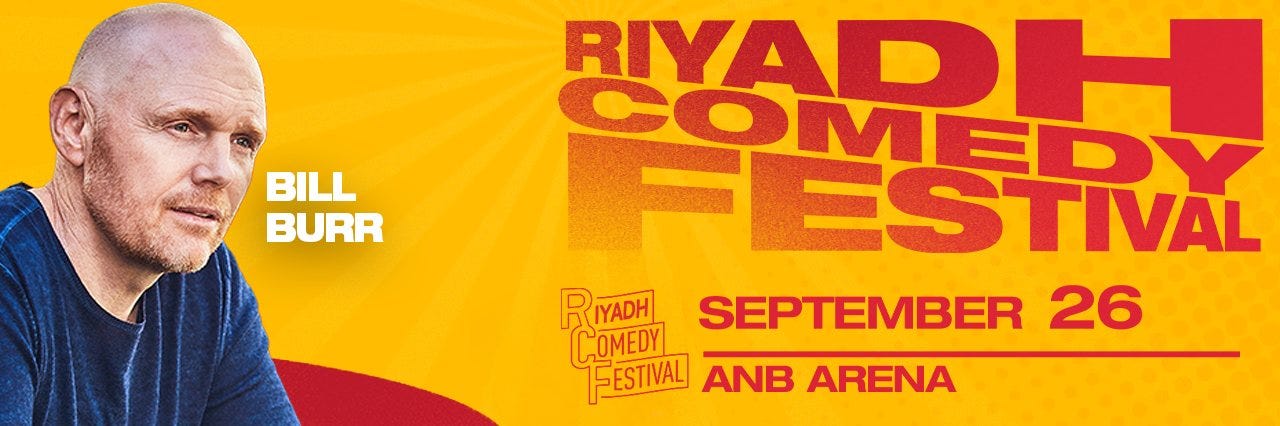
Which brings us to Bill Burr.
I don’t have much to add to the growing discourse. Check out what other comics are saying (the ones assailing him and the ones offering solidarity—in each case see which arguments are more convincing), and check out Burr’s own words. He’s in a hole, he keeps digging, and all the vitriol and self-righteous indignity speak volumes.
(I will add: unlike Chappelle and Louis CK, Burr is not only still near the top of his game, he’s built up considerable and well-earned goodwill on behalf of ridiculing the powerful, greedy, lazy, and cynical; he’s spent several years laughing at the people most in need of ridicule. He has, in short, done his job and acquitted himself, as a comedian and citizen. As such, to do this much damage, this quickly, and for such misguided & greedy reasons? It’s disconcerting and more than a little depressing. It’s also a metaphor for so much that’s gone off the rails in 2025.)
This debacle prompted me to revisit two pieces from last year where I weighed in on a couple of the more egregiously self-absorbed bulls in the China shop of America’s disintegrating democracy, Jerry Seinfeld and Bill Maher (both featured via The Good Men Project; here’s the Seinfeld piece and here’s the Maher piece).
Some excerpts from each, below:
But rather than focus on the low-hanging fruit of Seinfeld’s lamentable myopia and poor taste in role models, we should appreciate how America’s maestro of punching down has provided us with a teachable moment. If one looks even slightly below the surface of his (intentionally?) incendiary remarks, it’s obvious that what Seinfeld—echoing similar comments from compatriots disparate as Dave Chappelle and Tucker Carlson—craves is more space for people exactly like himself. The “why can’t we take a joke” mantra is transparent code for “why can’t I say whatever I want, and while I’m counting my millions must I suffer the indignity of peasants critiquing me?”
The takeaway here is one artists have been dramatizing for centuries: even if one becomes affluent and immune from meaningful societal consequences, one may still find oneself miserable, lonely, misanthropic (howdy, Elon Musk). The remedy, as writers ranging from Emily Dickinson to Zadie Smith reveal, is that one surefire way to fulfillment comes from seeking meaningful engagement, which involves being curious, developing empathy, and feeling what it means to be fully human. (Some might deride this as being “woke.”)
***
I’m left wondering if Maher has spent a single minute imagining being spirited away to a prison camp. How it would feel summarily being fired, without cause, and wonder where the next paycheck was coming from. Is Maher, who has made a career of punching down (something he shares with other wealthy, insulated yet curiously sensitive comedians like Jerry Seinfeld and Dave Chappelle), capable of fathoming cause and effect as the man he dined with reduces the economy and rule of law to rubble?
Powerful people don’t need to imagine this because they don’t have to. They don’t worry about these kinds of things happening to them because they never will. And by steadily eroding support for the Humanities, increasing numbers of toxic young bros can’t and won’t contemplate these things, because they’ve never been exposed to the kind of creativity that repels tyrants. Less students will read books that help them understand little of what’s happening in 2025 is new, that writers under authoritarian rule have described some of what we’re seeing, in great and painful detail.
Perhaps instead of platforming the oleaginous Steve Bannon (who, incidentally, does not lack access to a national appetite for the sewage he spews) Maher might interview any number of first-generation Americans who have fled the violence of fascist regimes. How valuable to his viewers to hear legal(!) immigrants describe what they’ve seen, and what we’re seeing. Maybe Maher could invite a grade schoolteacher (one from a Title One school might be especially appropriate, and illuminating) to discuss the challenges they face, daily, before lesson plans are even dealt with. Not click baity enough? Well, Maher could lower the bar considerably and simply speak with a painter or writer—or non-profit director—whose grants were terminated, for no reason other than anything having to do with “diversity” is now a target. He could even work in a joke about how today, in a twist too ironic for amusement, these marginalized artists are actually being canceled.
Instead of another tired joke about DEI, Maher might recall that comedians, once called court jesters, have always served a profound culture purpose. These clowns, with wit and courage, spoke truth to power, and not for ratings. More, they have typically been our first line of defense whenever inconvenient matters of censorship or lists of state enemies surface. If he tried, Maher could probably see the books burning, but that doesn’t smell like money. Punching up on behalf of the dispossessed doesn’t provide more security or access, so he turns his nose even higher, where the air reeks of Trump’s Fight Fight Fight cologne, now retailing at a modest $199 per bottle.
iv.
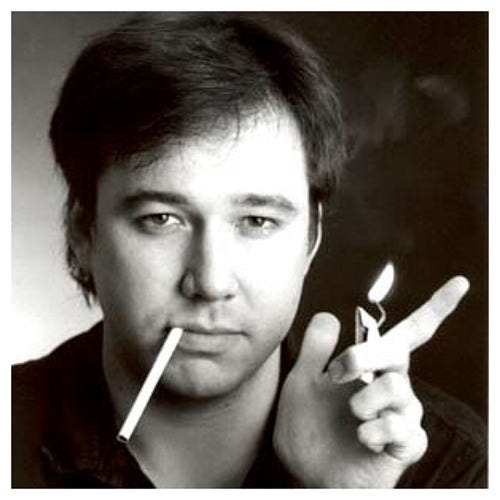
As usual, Bill Hicks was prescient, almost painfully on point (if you’re either unfamiliar with this American Genius or are interested in my thoughts on him, go here). And, proving everything stays the same but manages to get worse in America, here is Hicks lambasting Jay Leno “merely” for shilling Doritos. Imagine how he’d feel about Brothers Louis, Dave, and Bill for defecating not only on comedic, artistic integrity, but—and I really can’t believe I’m actually going here—betraying the spirit of American exceptionalism—the stuff we tell ourselves when we tell ourselves we’re different, we aspire to be better.
And for an absolute clinic on how it’s done, here’s Hicks on the ugly underbelly of America.
The saddest part? Not only has corporate America swallowed politics to the extent that the two are symbiotic parasites feeding off and replenishing each other, but we used to reserve this kind of vitriol only for business types and elected officials. Today, our court jesters are not telling jokes so much as becoming jokes. Nice work if you can get it.
v.
Postscript: Richard Pryor, The Once and Future GOAT
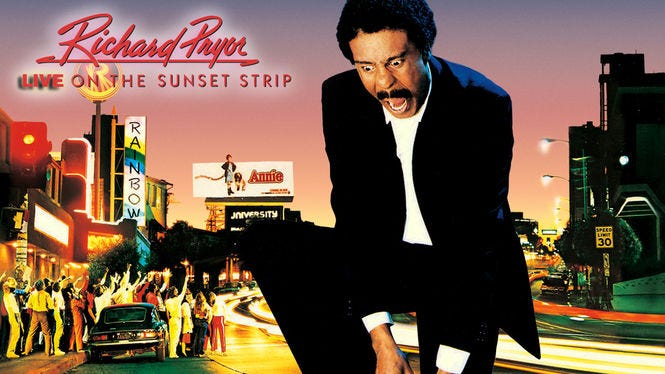
I consider Richard Pryor’s Live in Concert (’79) the single best stand up special in history. But Live on the Sunset Strip is possibly more important (maybe even better, if that even makes sense). The former is God-level genius where everything (every joke, every gesture, every second) clicks into place; the latter reveals a humbled and wiser GOAT, exploring everything from a trip to Africa (and, for the first time, reckoning with his own use of the “N-word”) to a frank and hilarious (yes, hilarious) discussion of his infamous freebasing debacle (described at the time as an accident, but actually a more than half-serious suicide attempt). That Pryor can “go there” and not only turn this into material that’s neither self-conscious *or* self-pitying, and make it LOL funny is perhaps the signal testament to his gifts.
There’s a poem entitled “Richard Pryor’s Flesh” that appears in The Blackened Blues (and recently showcased by the great The Blue Mountain Review); it being the 40th anniversary of his immortal Sunset Strip gig, I wanted to attempt a tribute; it started as an essay and turned into a poem (said no one ever). Huge thanks, again, to The Decadent Review for being a home to my humble work. And never mind all this blather, which should serve as a delivery device for the key takeaway: if you’ve never enjoyed this concert, cue it up to see an American Icon at the height of their inimitable powers.
Richard Pryor on the Sunset Strip, 1982: An Exegesis
I.
Here’s the thing about saints: they’re seldom esteemed
until they die. What’s lost in the transformation from sinner
to sublime is how they ascend, immortalized for the things
we watched them achieve, often what frightens or informs us.
II.
We worship them in death in direct proportion
to how much they electrify us, while we’re alive.
III.
The suffering, we’ll say, is entirely self-inflicted—
but the gift? God given. That’s a hustle that never fails.
IV.
Point is, being a human metaphor, the thing describing
itself? That’s a burden few humans are built to bear.
V.
Don’t call it a comeback, nobody said—but we all saw
you: larger than death; that billboard on Sunset Blvd.
VI.
Not Jesus, so much (too many lesser contenders for that
peculiar crown anyway); more like Lazarus: I’ve returned
from the dead, you didn’t say, being alive your epiphany:
you were blinded, but your gift was giving sight
to those who otherwise couldn’t see the light.
VII.
Metaphor as miracle: you strode to the stage, parting
the crowd not like Moses or even Judas—just a man,
who’d outgrown the n-word and all that hocus pocus.
VIII.
You said the words we couldn’t say.
You said the words you couldn’t say.
IX.
Miracles, as Christ could attest, ain’t easy;
every soul saved causes you to die a little bit,
because not faking it is what it takes
to make them believe. Plus, you died
for your own damn sins, but you tried
to save as many would-be fools—hoping
for heaven in ways we pay for—as possible.
X.
Make no mistake: priests are employed to recycle
an inflexible script; miracle workers make it up
as they go, saying shit we only need to hear once.
XI.
Certain persuasions are taught to believe the pope
is infallible. Pryor’s conviction? He was merely perfect.
XII.
On the Strip, a Last Supper of sorts:
disciples gathered round
and The Reverend Jesse in the house,
but the only man preaching on stage,
regal in red like the pope, or a pimp—
which is the rare word that can be both
ironic and off limits, at least in mixed company.
XIII.
Those of us acquainted with the actual world
and what it does to us have a weakness
for the fallen angels, especially those brave enough
to abide, burned up but not burnt out,
their odometers dizzy from spinning so fast
(but, we know, that’s where the fuel comes from,
and you knew not to fuck around and find out
what happens when we forget what got us here).
XIV.
Look at him transform right in front of us:
a lion, a wino, a gangster, a preacher, a pipe,
a little boy—also himself, a role he was born to play
but also one he should be forgiven if,
at times, it enervated him, even as the script
wrote itself, like attorney’s fees or obituaries.
This, you didn’t say, is the story of my life.
XV.
Never mind the Devil, temptation always appears
when we’re alone in the desert. The battle’s over
the heart & mind; how it’s won is what we do with
our gift while we have it—when the lights shine
brightest, being ready for another fight that ends
in seconds or, defying faith and fate, lasts forever.
Of course, Pryor spun his personal mishap into comedic gold, but—like so much of Pryor’s best material—it comes from a very deep, dark place. But Pryor, in addition to being the best stand-up comedian ever, was an exceptionally deep, dark man. The image of this genius, bottoming out on his freebase habit, lighting himself ablaze (attempted suicide? very painful and dramatic cry for help?) is sui generis; it’s a generational metaphor and, for me, one of the definitive tragedies that illustrates the toll our world takes on our most gifted but tormented souls.
Richard Pryor’s Flesh
Take, eat; this is my body which is broken for you…
(How many times did we hear that, back in the day?)
This cup is the new covenant in my blood…
(In remembrance of Who? Which Way Is Up?)
The light shines in the darkness…
(Do you see the light?)
And the darkness has not overcome it…
(Lead us not into temptation.)
But deliver us from Evil…
The church was our school and vice versa, both
things we outgrew as we grew out of everything
they beat into us. So many switches swinging
in the winter wind, breaking our backs because
this hurts you more than it does me, thy will be done.
Cast them into the furnace of fire—now we’re talking.
Every man who tells the truth has to take the heat:
Face it, eat it, bathe in it, and pour lighter fluid
on the flames—this is just what a genius does.
Sacrifice him there as a burnt offering…
You see, the gods demand abnegation, their alms.
Mere mortals can put cash in the basket,
but certain sorts of men pay a different way—
the kind of currency that leaves singed skin
and scars: that’s the price of admission.
When you walk through the fire, you will not be burned…
How? Bodies are only boats, surrounded by the spirits.
Why? If you have to ask you’ll never know.
Prove you mean it, that means you’re real.
This life only hurts because you’re alive.
(*These poems available in the collections The Blackened Blues and Kinds of Blue.)
