
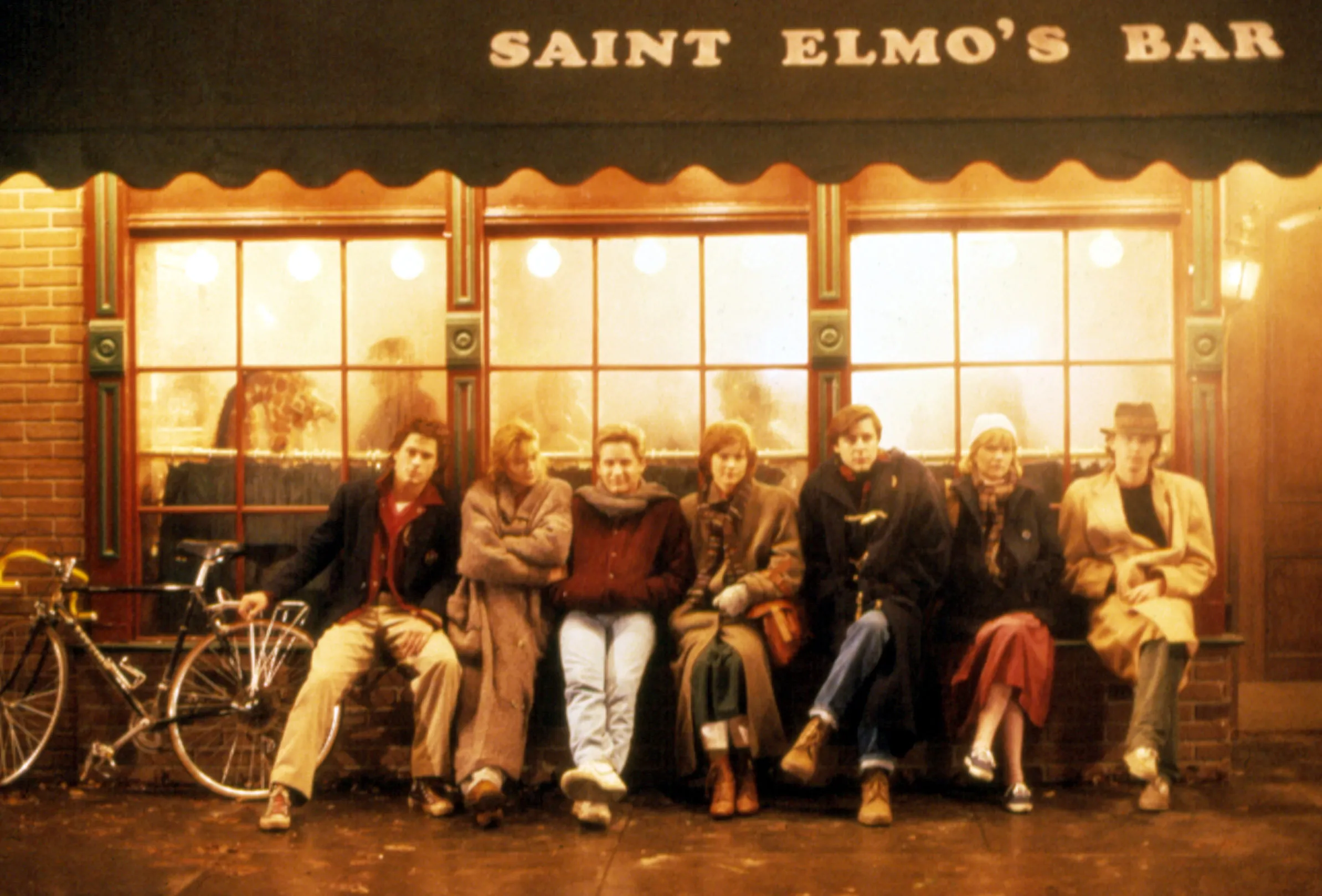
Forty years ago, this week, a movie that in many ways belongs on the Mt. Rushmore of misguided ‘80s fantasy/camp/delusion/propaganda (along with Top Gun, Ferris Bueller’s Day Off, and Scarface) as films that made heroes out of a motley crew of fops, cads, posers, and sociopaths. Only in America could a cautionary tale like Wall Street see Gordon Gekko turn, retroactively, into the good guy; only in America could we skip past irony and straight up have a stalker like Emilio Estevez’s Kirby (from St. Elmo’s Fire) be the “feel good” all American asshole, and lest I be accused—and not for the first time—of having no sense of humor, only in America could someone so devoid of personality, self-awareness, or soul could a scheming, scamming bro like Ferris Bueller get it over on everyone, the dude born on third base beating “the man” (combine Kirby and Ferris, with a healthy dose of Gekko watching Top Gun, and you have Donald Trump). Only in America.
St. Elmo’s Fire didn’t represent what America was, circa 1985, in any meaningful way. Rather, it represented what certain (very privileged, untalented, opportunistic) types of Americans wanted the country to be, and not surprisingly, it looked a lot like themselves: white, wealthy, able to stroll away from the real fires they started. We have a (literally) crooked line tracing from The Great Gatsby’s Buchanans to the Brat Pack, again all leading to the apotheosis of everything Ugly American in Donald Trump.
In this sense, nothing much has changed from 1985. Or 1925. Here we are, still being sold an America that talks a big game, and continues to happily count the bucks being made off this mirage.
Seems like an opportune time to revisit my extremely tongue-in-cheek poem “St. Elmo’s Fire” (which was drafted under the working title “I Nominate Rob Lowe as Billy Hicks saying Let’s Rock as the Whitest Moment of the ‘80s.”). GEN X rules: only we are allowed to make fun of the 1980s. Enjoy in all its Brat Pack Glory. (Shout out, again, to the team at The Blue Mountain Reviewfor publishing this one in 2023.)

St. Elmo’s Fire
First off, this was peak ‘80s, in that the ‘80s were
finally the ‘80s; not sad remnants of ‘70s hangovers—
domestic beer and shag carpets replaced by lack of shame.
Disco was dead and hair metal, God help us,
was ascendant, TV screens the size of PC monitors,
and, not unlike a movie, smoking on airplanes still a thing.
The actual horrors Reagan’s Revolution
not yet fully felt, at least by the types of people
flocking to see St. Elmo’s Fire in the summer of ’85.
And, this is important, irony was not
yet our default cultural setting; MTV
turning pallid lip-synchers into celebrities.
So, an actor like Rob Lowe could embrace
his Brat Pack prerogative as the pampered cad
who, we understood, was also a dreamer,
Because, of course, that’s how tortured geniuses
truly are; they drink and drug and lose jobs like it’s
a job, feeling the full weight of their white worlds.
Like a poor man’s Sisyphus with an 8 ball
on his back, trying to shake that shocked monkey
called accountability: this script needs a rewrite.
Only in 1985 could anyone with the final cut—
and so little common sense—decide an extended scene
of Billy blowing his sax signified that pretty boy pain.
The crowd, obviously, feeling his burden and luxuriating
In his brilliance, here was their own Lizard King,
incinerated, at last, in the bonfire of his vanity.
(This was a dark precursor to the truly ascendant
Cocktail, wherein a bar full of not-drunk-enough yuppies
are content to watch Tom Cruise throw bottles in the air.)
The cameras making love, and who could blame them,
to this impossibly mesmeric man-child who, mid-solo, claps
and says Let’s rock: the whitest moment of a very white decade.
Case closed, right? I mean, on a meta level this is the same film
in which the rebel from Breakfast Club becomes a Republican
and the male leads, arguably, are more comely than their counterparts.
But here’s where it gets ugly: maybe that’s one reason so few
of my friends (then; now) understand, much less appreciate jazz.
It’s scenes like this that make a Great White Mockery of Attainment.
We watch Kirby stalk an uninterested woman and it’s not sociopathy,
but a striver pulling himself up by his bootstraps, even if wingtips don’t
have straps, and Arthur Laffer (again, no irony) was taken seriously.
When Billy gets on that bus we know: it’s all going to work out
and if his wife and kid need to suffer for him to succeed, they will
all come out okay; and his inevitable redemption will have been earned.
This flick suggests what the decade signified: if we close our eyes
we’ll remember that Happy Endings aren’t free, but they’re possible
if you’re lucky to have parents—or producers—whose checks always clear.

