
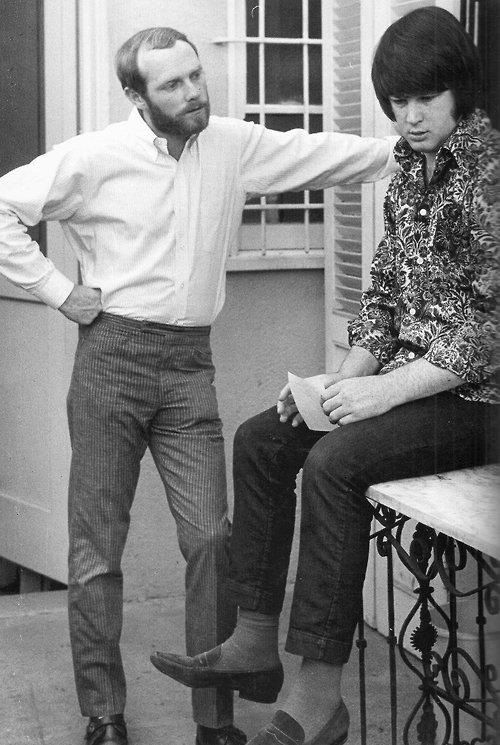
Brian Wilson could hear everything. The miraculous sounds in his mind. The sound of history being made in real time: a recording studio the laboratory where he worked on his beautiful monster. The imagined sounds of fans around the world blown away by his “teenaged symphony to God.” And, increasingly, the skeptical and dismissive sounds of his bandmates.
By 1966, the “Good Vibrations” Wilson was picking up weren’t making the money flow like the surf off Waimea Bay. Finally, a sort of fever broke courtesy of Mike Love, who neither understood nor approved of the ambitious and psychedelic direction things seemed headed. “Don’t F with the formula,” he allegedly snarled at his brilliant, exceptionally sensitive cousin.
These words, which Love has always denied uttering, endure, equal parts apocryphal and ideal distillation of the cynicism, arrogance, and entitlement that has made him so loathed while he eagerly hit the oldies circuit, recycling the hits Wilson—who spent many years in a foggy spiral of mental illness—wrote for the band. The formula, everyone understood, meant innocuous feel-good tunes about cars, girls, and surfing, the subject matter that helped one band redefine both a state and a certain state of mind.
Wilson couldn’t get SMiLE, a would-be masterwork that might not only have given “Sgt. Pepper” heady company during the Summer of Love, but change the way we understand The Beach Boys, The Beatles, and the ‘60s, out of the starting gate. In recent decades, when fans contemplated Mike Love, they imagined a shameless and soulless hack counting his dough; when fans considered Wilson, it was invariably the sad spectacle of a desolate has-been sitting in his sandbox, staring at the grains between his toes like so many lost dreams. Fortunately, Wilson made an unexpected recovery and was able to enjoy a well-earned and extensive victory lap for most of the 21st Century. (A great deal more on all that, here.)
Now that Brian Wilson has passed and been canonized, without controversy, as the American Mozart, “Don’t F with the formula” provides a welcome opportunity to reappraise not only our understand of Wilson’s fragile genius, but the way we always tend to treat creative innovation when it’s in our midst.
Any tribute or obituary acknowledging the uncomfortable topic of his nervous breakdown(s), use of drugs, and mental anguish is certainly welcome so we might further demystify and more productively discuss such things. What remains unexplored to any meaningful extent is the impact his band of brothers, not to mention the broader public, had on his psyche, even as he pushed boundaries to change pop music, permanently and for the better.
While we’re reminded that Pet Sounds is one of the seminal albums of the ‘60s (of all time), influencing everyone from The Beatles to any contemporary band experimenting with the chemistry of sweet harmonizing, we tend to overlook that it was considered a commercial dud, certainly in comparison with the Beach Boys’ previous, less ambitious work. It was, in fact, the tepid response to Wilson’s masterpiece that inspired him to shoot higher and go bigger (with SMiLE), prompting Love—and others—to provide reluctant, increasingly grudging support throughout 1966 and into 1967—leading him to abandon the sessions for an album some of us now recognize as the best work he ever did.
This unfortunate series of events is at once a Brian Wilson and Beach Boys story, but it’s also a familiar and regrettable part of American cultural history. While we can boast at having produced miracles ranging from Moby Dick to The Great Gatsby, Citizen Kane and Blade Runner, each was met with, at best, ambivalence. Maestros like Charles Mingus and Thelonious Monk (and so many other musicians we now laud as giants of the jazz and blues idioms) struggled to earn a living from their work.
It’s less a lesson to learn so much as cliché that we tend to overlook the best amongst us until they’re long gone. In America we take this several steps further, having an indifference (and, of late, a growing hostility) toward supporting the arts, dismissing anything out of the ordinary. We are, in short, wonderful at creating martyrs, a tragic legacy we do little to learn from or ameliorate.
Artists have forever fought against apathy and lack of institutional support; the avant-garde has included those who, in following their own unique path, blazed trails often misunderstood or resisted. Many of these people, now recognized as indispensable heroes of American culture, were ill-served not only by audiences, but editors, publishers, and the usual gatekeepers—those known for having deep wallets, shallow imaginations, and minimal tolerance for risk.
One moral from the Brian Wilson saga to emphasize is that rebels who F with formula are the ones who successfully move art and culture—not to mention civilization—forward. We can consider the Constitution, as well as the Gettysburg Address taking their places alongside Citizen Kane and Their Eyes Were Watching God as documents that riled up the complacent, challenged prevailing mores, and provided a template for advancement. Here we can begin connecting dots between what art does and why it shapes and influences culture, usually for the better. When I listen to Pet Sounds and especially SMiLE today, I hear not only the triumph of one genius’s vision, but a soundtrack for Fing with the Formula.
Refusing to F with the formula perpetuates imitation, conformity, stagnation. Of course, it can be the more profitable path, as Mike Love implied: being a copycat is typically a better career move, even if one loses one’s soul in the process. The formula, in other words, is what worked before, meaning it might not work again. The formula sustains a status quo that is practically by definition exclusive, limited, limiting. The formula, finally, is not just a money-making device, it’s the methodology very powerful and wealthy entities sell to advertise, entertain, and distract.
Needless to say, the crisis is easily explained as it relates to creativity but has sociopolitical implications. Government funds are flowing in one direction (hint: those who need them least), and computerized algorithms are doing more than human beings to determine who and what gets sustained and subsidized. With the unchecked proliferation of AI, to F with the formula means resisting stale stories and siloed information; originality is the antidote to recycled data.
The silver lining? We have the power to make a difference and possibly rechart the course of history. Every time you subscribe to a magazine, buy a book, or pay to download an independent musician’s album you are undermining the engines of cynical, curated content. You are making a choice to refuse the manufactured reality boring people in boardrooms serve up like so much fast food. F with the formula and help those people brave enough to create the kind of content that makes life worth living.
